 Call us today


Knowing how to spot an american dog tick quickly can mean the difference between a routine yard walk and an unexpected trip to the doctor or vet. For homeowners across the Midwest, this species ranks among the most frequently encountered ticks on dogs, family members, and wildlife.
Quick Overview of the American Dog Tick (Dermacentor variabilis)
The american dog tick, scientifically known as Dermacentor variabilis, is one of the most common hard ticks biting dogs and humans east of the Rocky Mountains. Established populations have existed throughout Iowa, Missouri, Nebraska, and Kansas since the mid-20th century, making this tick species a persistent concern for Midwest residents.
Often called the wood tick, this species is frequently confused with the blacklegged tick (deer tick) and brown dog tick. However, understanding the differences matters significantly for disease risk assessment.
The primary health concerns associated with american dog ticks include:
Rocky Mountain spotted fever (the most significant threat)
Tularemia
Tick paralysis
Importantly, american dog ticks are not considered primary vectors of Lyme disease—a common misconception that leads to unnecessary worry or misplaced confidence.
Miller Pest Solutions provides tick identification assistance and professional yard treatments for residential and commercial properties throughout IA, MO, NE, and KS.
How to Identify an American Dog Tick
Accurate visual identification starts with examining size, body shape, color patterns, and where the tick was found. The american dog tick exhibits distinctive features that separate it from other tick species once you know what to look for.
Size characteristics:
Unfed adults measure approximately 5–7 mm long (roughly the size of a small watermelon seed)
A fully engorged female can expand up to approximately 15 mm
Adult males remain smaller and do not swell dramatically
Body shape and structure:
Oval, flattened body when unfed
Hard shield (scutum) visible behind the head
Eight legs in nymphs and adult ticks
Festooned (scalloped) edges around the rear margin
Coloration and markings:
Dark brown body with reddish-brown tones
Ornate off-white to grayish markings on the scutum
Markings more obvious on females due to smaller scutum size
Sex differences:
Adult female: smaller scutum that doesn’t cover the whole back; swells dramatically during a blood meal
Adult males: patterned scutum covering most of their back; remain relatively flat even after feeding
Immature stages:
Larvae have six legs, are very small and light brown (grain of sand size)
Nymphs are slightly larger with eight legs and darker brown coloring but lack bold adult ornamentation
American dog ticks are commonly found crawling on dogs’ heads, ears, neck, and shoulders after walks through tall grass, grassy fields, or trail edges.
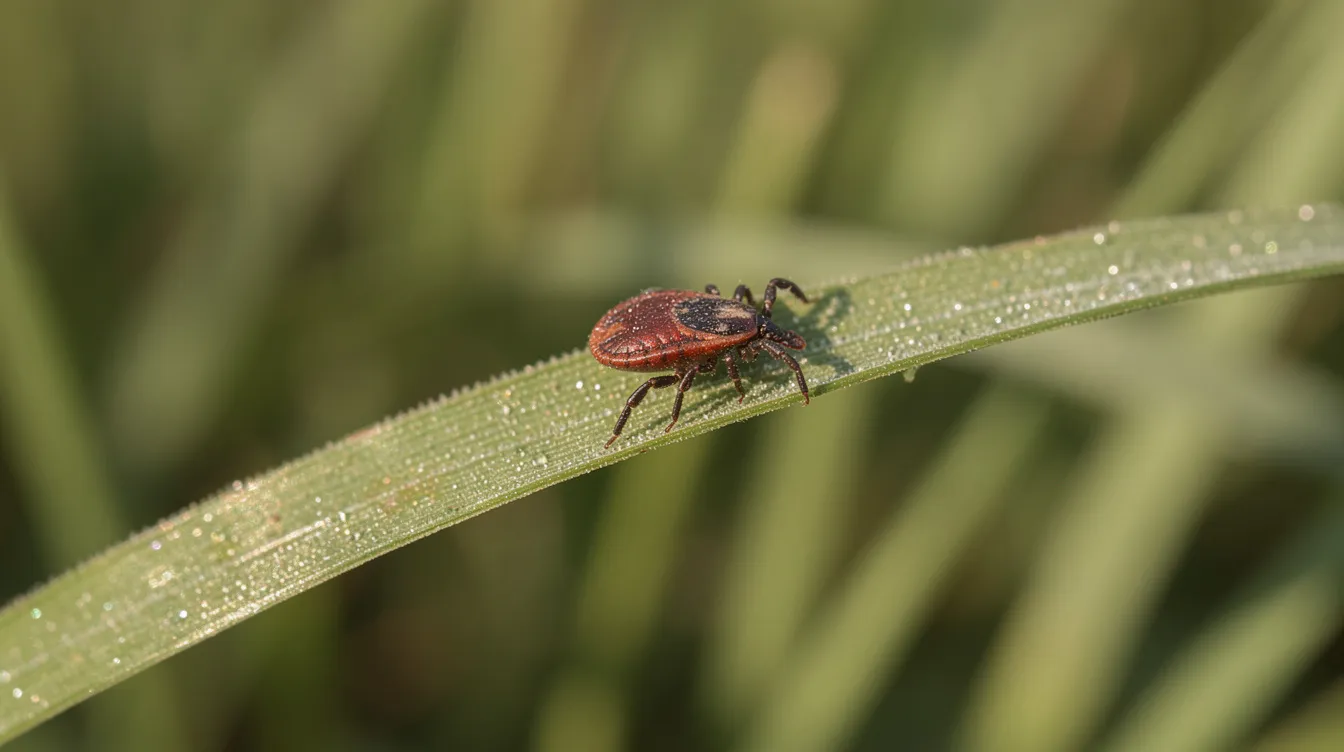
Characteristics of Adult American Dog Ticks
Adult American dog ticks (Dermacentor variabilis) are among the most recognizable tick species encountered across the Midwest and much of the eastern United States. These ticks are especially important to identify because they are primary vectors of Rocky Mountain spotted fever and can also transmit tularemia and tick paralysis—serious tick-borne illnesses that affect both humans and pets.
Adult American dog ticks are notable for their dark brown body adorned with distinctive off-white or grayish markings on their backs. Adult females are larger than adult males, especially after feeding, and can reach up to 1/2 inch in length when fully engorged. Adult males, while smaller and flatter, are easily identified by their ornate patterned scutum that covers most of their back. The adult female’s scutum is smaller, allowing her body to expand dramatically during a blood meal.
These ticks are slow feeders, with adult females often remaining attached to a host for up to two weeks as they take in a blood meal. This prolonged feeding period increases the risk of disease transmission, particularly for Rocky Mountain spotted fever. Unlike the deer tick (blacklegged tick), which is the main vector for Lyme disease, the American dog tick does not typically transmit Lyme disease. However, it is a significant concern for other tick-borne diseases, including tick paralysis—a rare but potentially life-threatening condition caused by a neurotoxin in the tick’s saliva.
Adult American dog ticks readily feed on a variety of hosts, including small mammals, domestic animals like dogs, and humans. They are most active during the spring and early summer, especially in grassy fields, along trail edges, and in areas with moderate tree cover and abundant leaf litter. Their adaptability means they can also be found in suburban yards and urban green spaces, wherever host animals are present.
The life cycle of the American dog tick can span up to two years, with adults capable of surviving long periods without feeding. This resilience, combined with their ability to thrive in wooded areas, tall grass, and even transitional zones between forests and lawns, makes them a persistent presence in the Midwest. Other tick species, such as the lone star tick (known for transmitting ehrlichiosis and red meat allergy), the Gulf Coast tick, and the invasive Asian longhorned tick, may also be encountered in similar habitats, but each has unique markings and disease risks.
To reduce the risk of tick bites and disease transmission, it’s essential to take preventive measures when spending time outdoors. Wearing long sleeved shirts and light colored clothing, using EPA-registered tick repellent, and performing regular tick checks on yourself and your pets are all effective strategies. If you find an American dog tick attached, remove it promptly with fine-tipped tweezers using steady pressure to minimize the chance of infection.
By understanding the characteristics and habits of adult American dog ticks, you can better protect your family and pets from tick-borne illnesses. Stay vigilant during the active spring and early summer months, especially in areas with dense vegetation or where wildlife is common, and consider professional tick control services for ongoing peace of mind.
American Dog Tick vs. Other Common Ticks
Distinguishing american dog ticks from blacklegged ticks, lone star tick, and brown dog ticks directly affects disease risk assessment. Each species transmits different pathogens, making accurate identification essential.
Tick Species | Key Markings | Typical Size (Adult) | Main Diseases | Common Locations |
|---|---|---|---|---|
American Dog Tick | Off-white ornate pattern on scutum | 5–7 mm unfed | Rocky Mountain spotted fever, tularemia, tick paralysis | Grassy areas, trail edges, meadows |
Deer Tick (Blacklegged) | Dark scutum, reddish-orange body, no ornate pattern | 3–5 mm unfed | Lyme disease, anaplasmosis | Wooded areas, leaf litter |
Lone Star Tick | Single white dot on female; scattered white flecks on male | 4–6 mm unfed | Ehrlichiosis, red meat allergy (Alpha-gal), heartland virus disease | Southern and eastern U.S., lower Midwest |
Brown Dog Tick | Uniformly reddish-brown, no white markings | 3–4 mm unfed | Rocky Mountain spotted fever (in some regions) | Indoor kennels, dog runs |
Gulf Coast Tick | Ornate markings similar to american dog tick | 4–6 mm unfed | Rickettsia parkeri rickettsiosis | Coastal regions, southern range |
Asian Longhorned Tick | Reddish-brown, no ornate markings (invasive species) | 2–3 mm unfed | Under investigation for diseases transmitted | Eastern U.S., expanding range |
Adult blacklegged ticks are generally smaller and darker than american dog ticks, and they serve as the key vector for Lyme disease. If you’re unsure which tick species you’ve found on your property in IA, MO, NE, or KS, Miller Pest Solutions can assist with identification and risk assessment.
Life Cycle of the American Dog Tick
Dermacentor variabilis is classified as a three host tick, meaning larvae, nymphs, and adults each feed on different individual hosts throughout the tick life cycle. The full life cycle typically requires about two years in most U.S. regions but can compress into a single season under ideal warm, humid conditions.
Each active life stage requires a blood meal to molt to the next stage, and adults need blood to reproduce. Remarkably, adult ticks can survive up to two years without feeding, making them persistent in yards, fields, and along trails.
Egg Stage
Gravid females drop off hosts after becoming fully engorged and seek protected outdoor areas to deposit eggs. A single adult female lays roughly 4,000–6,500 eggs in large clusters within leaf litter or dense vegetation.
Key egg stage facts:
Tiny, round, and dark brown in appearance
Eggs hatch within 2–6 weeks depending on temperature and humidity
Faster hatching occurs in warm, moist conditions
No direct bite risk but represents future infestation potential
Larva (“Seed Tick”) Stage
After eggs hatch, larvae emerge ready for their first blood meal. These “seed ticks” are extremely small—about the size of a grain of sand—and pale to light brown with only six legs.
Larvae remain close to ground level in leaf litter or low vegetation, waiting for small mammals like mice, voles, and chipmunks. Once a nymph feeds successfully over several days, it drops off to molt. This life stage can last weeks to months depending on host availability and environmental conditions.
Nymph Stage
Nymphs are larger and darker than larvae, with eight legs and a more visible oval body. They commonly feed on small animals including mice, chipmunks, and rabbits, occasionally biting humans and pets.
During this stage:
Nymphs are active late winter through fall in many regions
A nymph feeds for 3–10 days before dropping off
Nymphs can survive several months unfed in brushy and grassy areas
Peak activity often occurs in mid summer
Adult Stage
The adult stage is easiest to recognize due to larger size and the characteristic reddish-brown body with whitish-gray ornamentation. Adults prefer larger mammals such as dogs, deer, livestock, and humans, often attaching to highly vascularized areas like the head, ears, neck, and back. Adult American dog ticks can live for up to two years without feeding, but they typically feed on larger animals like dogs and deer.
In the Midwest, adult questing appears highest from April through June, though adults may remain active into summer in shaded or moist habitats. Adult males die soon after mating, while females engorge over about a week to 14 days before dropping off to lay eggs.

Habitat and Geographic Range
American dog ticks thrive in outdoor environments where wildlife and domestic animals move through grass and brush. Their geographic range extends primarily east of the Rocky Mountains, with additional populations documented on parts of the Pacific Coast including coastal California, Oregon, and Washington.
Preferred habitats include:
Tall grass and grassy fields
Meadow edges and overgrown field margins
Trail and road edges with little tree cover
Low shrubs and transitional zones between wooded areas and maintained lawns
Roadside ditches, pasture edges, and suburban greenbelts
In warmer regions, populations may remain active longer, though the species shows clear seasonal patterns everywhere. American dog ticks rarely establish permanent indoor infestations—they typically enter homes on pets or clothing and do not reproduce successfully indoors.
Increasing urban green spaces and wildlife corridors have brought this tick closer to residential yards throughout the Midwest, making regular maintenance and professional treatments increasingly important.
Feeding Behavior and Seasonal Activity
American dog ticks are blood-feeding ectoparasites that use “questing” behavior to locate hosts. Adults and nymphs climb grass or low brush, holding out front legs to detect heat, carbon dioxide, and movement from passing animals. When a suitable host brushes past, ticks latch on quickly.
Host preferences by life stage:
Larvae and nymphs: primarily small mammals (mice, voles, chipmunks, rabbits)
Adults: dogs, deer, livestock, and humans
The american dog tick feeds for varying durations depending on life stage. Adults usually feed for up to a week or longer (females being slow feeders requiring 5–14 days for full engorgement), while larvae and nymphs feed for several days before dropping off.
Midwest seasonal patterns:
Adult American dog ticks begin questing in early spring and are most active from late spring through summer, specifically from April to August
Larvae active late spring and early summer
Nymphs active spring through fall
Minimal activity during winter months
Diseases Associated with American Dog Ticks
While not all american dog ticks carry pathogens, this species can transmit several significant human diseases and affect domestic animals. Understanding disease transmission risks helps you respond appropriately after any tick bite.
American dog ticks are not considered primary vectors of Lyme disease—that distinction belongs to deer ticks (adult blacklegged ticks and their nymphs).
Rocky Mountain Spotted Fever (RMSF)
American dog ticks serve as major vectors of spotted fever caused by Rickettsia rickettsii. This tick borne illness presents with:
Sudden fever and severe headache
Muscle aches
Characteristic spotted rash appearing 2–4 days after fever onset
Symptoms typically begin within 2–14 days after a bite and can progress rapidly. Dogs can also develop RMSF, showing fever, lethargy, joint pain, and poor appetite. Early antibiotic treatment (commonly doxycycline) is critical.
Tularemia
American dog ticks can transmit Francisella tularensis, causing tularemia. Human cases remain relatively rare but present with:
Sudden fever
Skin ulcers at the bite site
Swollen, painful lymph nodes
Tularemia is treatable with specific antibiotics, making early medical evaluation vital.
Tick Paralysis
Some female american dog ticks produce a neurotoxin causing tick paralysis in dogs, cats, and rarely humans. Signs include progressive weakness beginning in the hind legs, difficulty walking, and potentially respiratory distress.
Tick removal typically leads to rapid improvement within 24–48 hours. Check pets carefully for attached ticks if sudden weakness occurs during tick season.
Preventing and Controlling American Dog Ticks
A layered approach combining personal protection, pet care, yard management, and professional treatment provides the most effective defense against tick borne illness.
Personal protection:
Wear long sleeved shirts and long pants
Tuck pants into socks
Choose light colored clothing for easier tick detection
Apply EPA-registered tick repellent (DEET, picaridin, or permethrin-treated clothing)
Pet protection:
Use veterinary-recommended tick preventatives
Conduct routine tick checks after walks
Remove attached ticks promptly
Yard management:
Keep grass trimmed short
Remove brush and leaf litter
Create clear borders between wooded areas and lawn
Discourage wildlife hosts by managing bird feeders and securing trash
Frequent use of walking trails, dog parks, and field edges in Iowa, Missouri, Nebraska, and Kansas increases exposure, making proactive prevention especially important from April through June.
Miller Pest Solutions offers targeted outdoor tick treatments, integrated pest management plans, and recurring service options aligned with local tick season. Contact us for assessment, identification assistance, and customized tick control for your home or commercial property.
Safe Removal and When to Call a Professional
Quick, proper tick removal lowers the chance of disease transmission and minimizes skin irritation at the bite site.
Correct removal technique:
Use fine-tipped tweezers
Grasp the tick as close to the skin as possible
Pull upward with steady pressure—avoid twisting, crushing, burning, or using oils
Clean the area and hands with soap and water or rubbing alcohol
Save the removed tick in a sealed container or clear tape with the date and location of the bite in case identification is needed later.
Seek medical care if:
Fever, rash, or flu-like symptoms develop
Redness or swelling increases at the bite site
Symptoms appear within days to weeks after the bite
Contact Miller Pest Solutions when:
You find ticks repeatedly on people or pets
Commercial properties show signs of tick activity
You’re uncertain about tick species identification
Combining safe removal practices with ongoing prevention and professional services keeps american dog ticks under control around your property. Don’t wait until tick season peaks—schedule an assessment today to protect your family, pets, and peace of mind.


